A Song That Saves Lives: Tsunami Awareness Through Music in Timor-Leste
This week marks the beginning of the annual Asia-Pacific Forum on Sustainable Development (APFSD), where countries in Asia-Pacific will gather to take stock of their progress towards the Sustainable Development Goals (SDGs) and discuss their plans for a brighter future. Development means more than economic, social or infrastructural well-being: it is a commitment to anticipating future challenges. Given that disaster hazards can disrupt development gains, preparedness and resilience are key to achieving the SDGs and ensuring that momentum is maintained.
“Tsunami, tsunami, run away from the sea.
Tsunami, tsunami, evacuate quickly.”
The children’s voices ring out across the courtyard of Marinir Primary School, on the outskirts of Timor-Leste’s capital, Dili. Dressed in light blue uniforms, the boys and girls look up admiringly at Otopsy, his long dreadlocks swinging side to side as he sings into the microphone. His iconic pink cap seems powerless against the scorching midday sun on this November day, but his energy never falters.
A Song to Remember
The children pick up the lyrics instantly. Soon they are singing along, arms swaying like waves, hands clapping, voices rising with excitement. The song was designed to stick. Composed with clear tsunami risk and preparedness messages and set to an easy-to-remember tune, it helps children and young people learn what to do as a tsunami approaches and, crucially, remember it. Research shows that information embedded in music is more easily retained, regardless of the subject matter — especially by children.
Marinir Primary School sits at the end of a dirt road, just a few hundred metres from the coast. Coconut trees line the beach nearby and wooden fishing boats are pulled up on the sand, ready for the next morning’s catch. The setting looks idyllic, but it was here that tragedy struck 30 years ago. In 1995, an offshore earthquake triggered a tsunami that killed nearly a dozen people, injured 19 and devastated Marinir village, destroying homes, damaging fishing boats and leaving hundreds of cattle missing. A small memorial hut on the beach remembers the victims, its faded blue paint and corrugated roof weathered by time.
An entire generation has grown up since then. Many do not know about the event, contributing to a widespread belief that Dili is safe from tsunamis. Official hazard maps tell a different story. This is one of the reasons Timor-Leste’s Civil Protection Authority participated in a regional tsunami tabletop exercise coordinated by the UN Educational, Scientific and Cultural Organization’s Intergovernmental Oceanographic Commission (UNESCO-IOC) earlier in 2025.
Challenging a Dangerous Myth
To counter this false sense of security, the UN Office for Disaster Risk Reduction (UNDRR), together with the Civil Protection Authority, UNESCO-IOC and Pacifico organized a public awareness week in Timor-Leste to mark World Tsunami Awareness Day.
At the heart of the campaign was the tsunami song, produced by the local artists Otopsy, LYF, Etson Caminha and Malena. The musicians performed live at six schools across Dili in early November 2025. Their performances were paired with classroom role plays, board games and drawing activities for younger children, all designed to teach how to recognise tsunami warning signs, make quick decisions and protect one another.
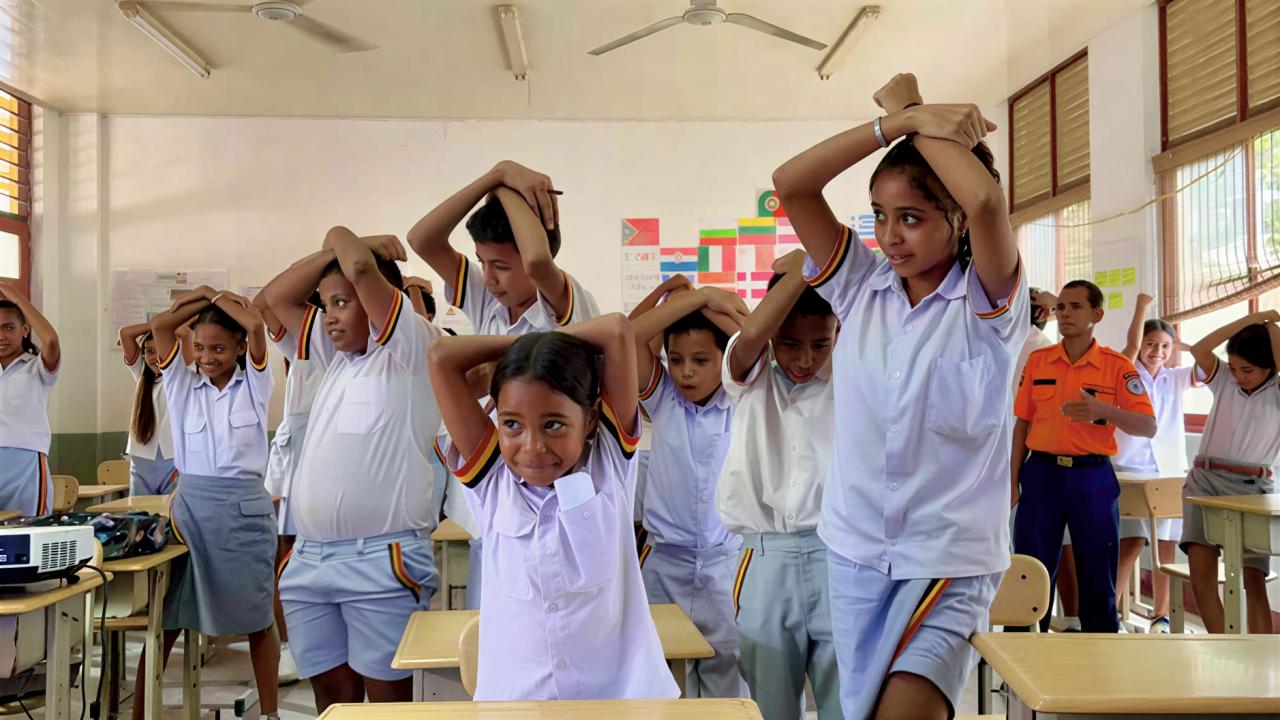
The scene shifts to a classroom. The teacher stands at the front and claps her hands three times — the signal. Instantly, the children duck under their desks. White uniforms scrape across the bare concrete floor. Some children shake their desks to mimic an earthquake. “Let’s go, let’s go, let’s go,” the teacher shouts, gesturing towards the door. Covering their heads with their arms, the children stream outside into the open. The teacher glances back to make sure no one is left behind, then begins counting her students in the courtyard. It is the first time she has carried out such an exercise. Trained by officers from the Civil Protection Authority, she looks proud and visibly moved.
Playful Learning, Serious Lessons
“Don’t say ‘Oh Maria’, ‘Oh my brother’ — act now.
If the sea pulls back, don’t think it’s safe to go fishing.”
The teenagers at Finantil High School, in a neighbourhood near the former UN peacekeeping headquarters, are not easily impressed. But rapper Atrix is exactly to their taste, and a welcome change from geometry and literature. The message of the tsunami song lands.
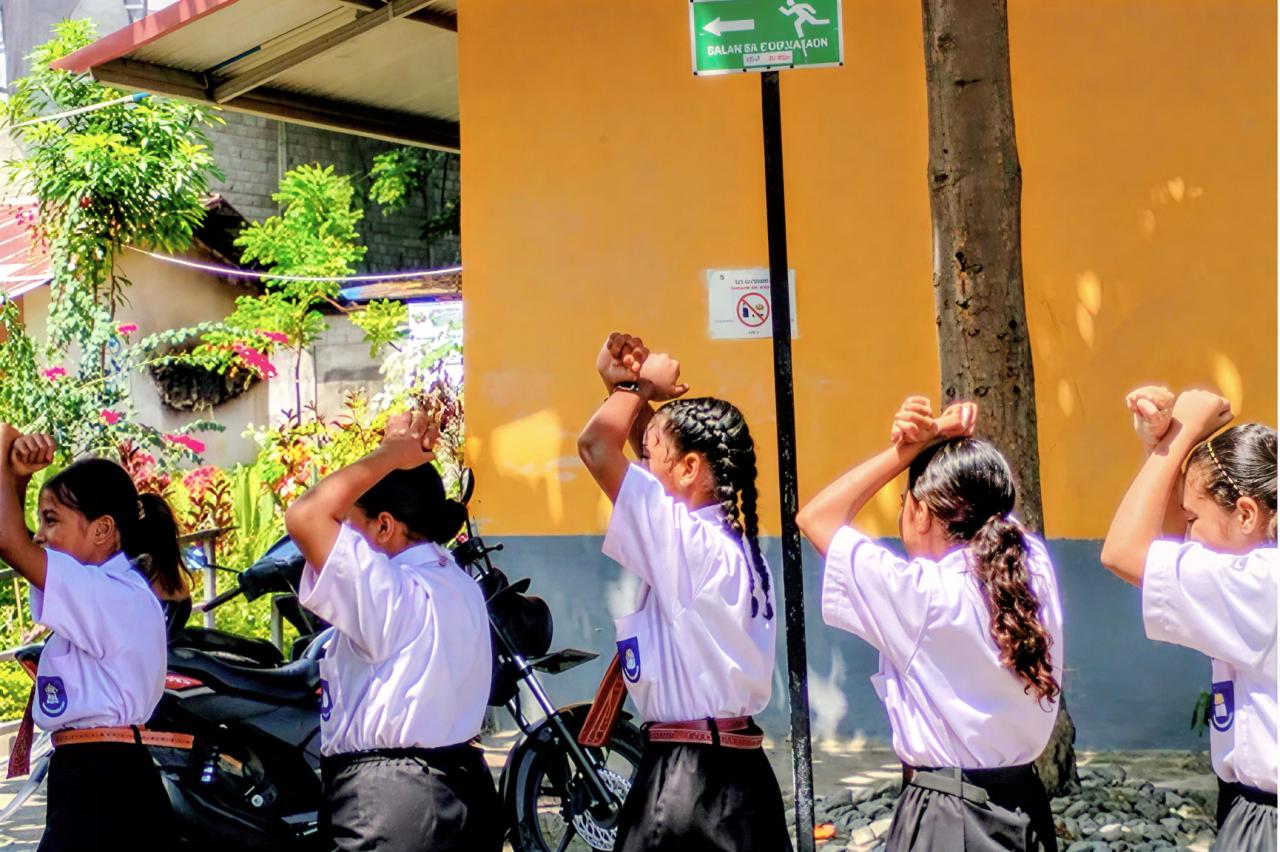
At the Portuguese School, students throw themselves into a role play simulating a tsunami alert. Taking on the roles of class leaders, teachers and school principals, they debate decisions under pressure. Through the Runami board game — short for “run from tsunami” — they learn facts about tsunamis, with each correct answer bringing them one step closer to safety away from the coast.
Leaving No One Behind
An inclusion lens is woven throughout the week. The organization of persons with disabilities, Ra’es Hadomi Timor Oan, challenges students to think beyond themselves: How would a warning reach an elderly grandparent? What about a neighbour who is blind or a friend temporarily on crutches? Together, they discuss how communities can support everyone to evacuate safely.
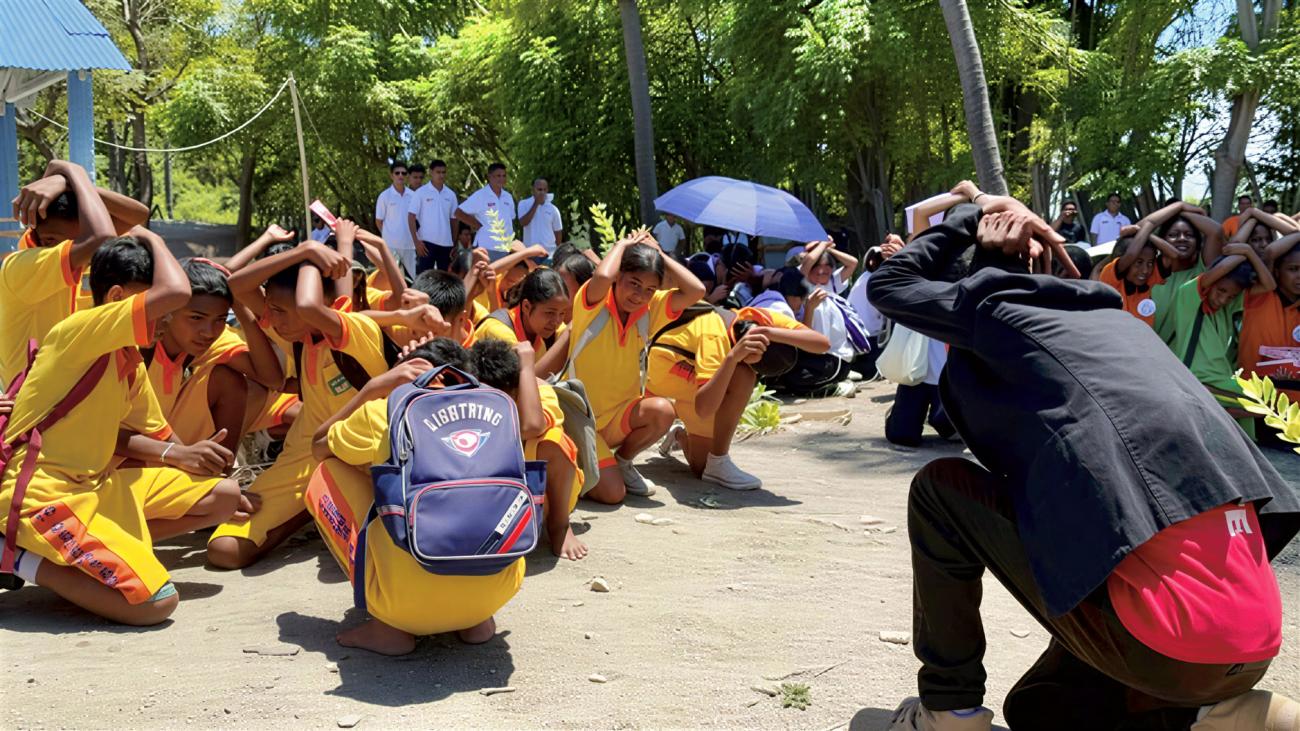
The week culminates in a tsunami evacuation drill and symbolic walk from the beach to a temporary inland evacuation site. Around 150 children from different schools take part, joined by the musicians, community representatives, survivors of the 1995 tsunami, local and national authorities, and representatives from the United Nations and embassies in Dili.
The tsunami song has since become a regular part of the artists’ repertoire. Played on local radio stations, it continues to travel across the country, long after Tsunami Day itself. Its message echoes on:
“The sea is beautiful, the sea is our friend.
But sometimes, the sea can be very dangerous.”
The Tsunami Awareness Week formed part of a broader engagement through which UNDRR supports Timor-Leste in strengthening its early warning systems, including improving risk data, governance and preparedness at the community level.
This initiative was made possible with the generous support of Japan, Portugal and Australia, and the close collaboration with local artists and partners.
This story was originally published by UNDRR. Please visit the UN team's website for more information about the UN's work in Timor-Leste.