Colombia's Digital Future is Being Built by Youth
For connectivity to be meaningful, it must be accompanied by digital skills, access to decent work and the ability to build and grow a business, safe digital environments and a real voice in the policies that shape the digital world. It must also be free from the territorial, gender and social inequalities that already mark life offline.
The data makes the urgency plain. Internet penetration among Colombian youth is high — but what young people do online tells a different story. According to the International Telecommunication Union (ITU), while 92 per cent use digital platforms to participate in social networks, only 46 per cent use them to take an online course, and just 9 per cent to look for a job or submit a job application. Connectivity exists. Economic opportunity does not follow automatically.
Programmes like SENATIC have already trained more than 200,000 people — 51 per cent of them women — demonstrating the country's capacity to build digital talent at scale. The challenge now is connecting that talent to real economic opportunity, particularly in regions like the Pacific and Caribbean where structural barriers compound the gap through weaker infrastructure, fewer employers and limited access to professional networks and markets.
That talent is already there. Colombia's young people are shaping the country's digital future through content creation, civic tech, entrepreneurship and grassroots innovation. But for millions living in the Pacific and Caribbean regions, the promise of the digital economy remains out of reach. The infrastructure is expanding. The opportunity is not.
This is the gap the Inclusive Digital Transformation Facility (IDTF) was designed to close through its Meaningful Connectivity Window.
Supported by the Joint SDG Fund and the European Union, and led by the United Nations system in Colombia, the IDTF repositions connectivity not as an end in itself, but as a gateway to decent work, entrepreneurship and meaningful civic participation.
Where the Future is Already Being Imagined
In May 2026, the Meaningful Connectivity Window brought its work to the field, joining two of the country's most prominent digital events to connect directly with young people, entrepreneurs and institutional partners.
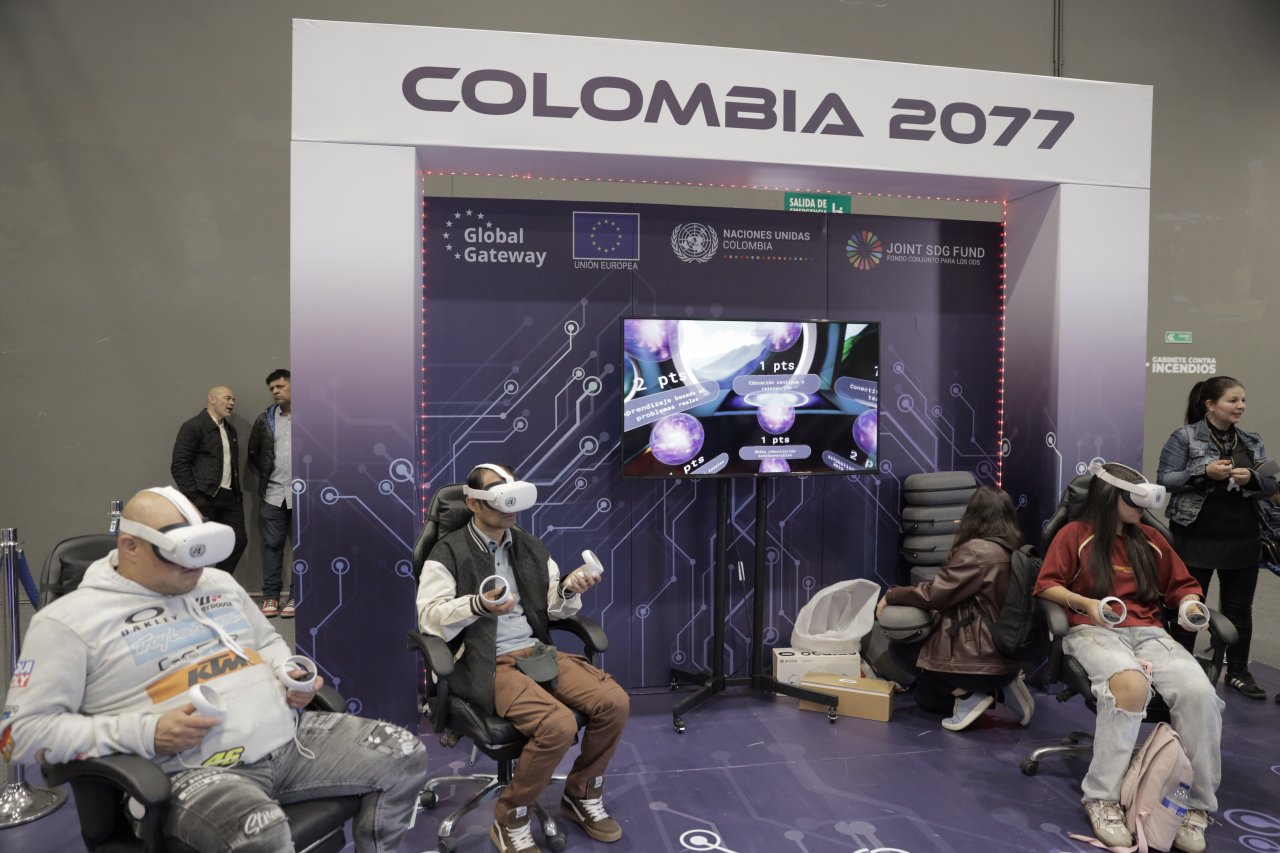
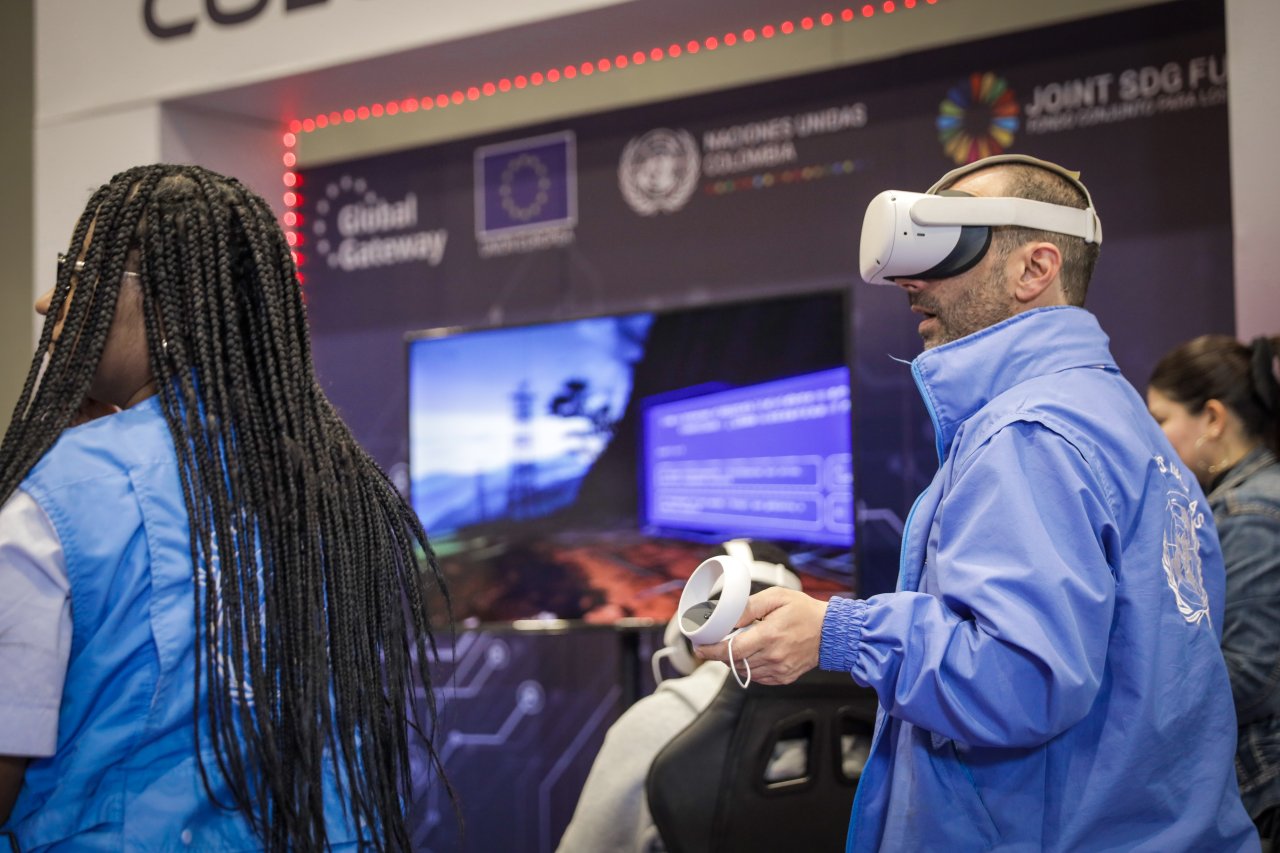
At Colombia 5.0, the country's flagship digital transformation summit, organized by the Ministry of Information and Communication Technologies (MinTIC), the UN and the EU, an interactive space offered young people the chance to experience the country's digital future first-hand. Participants put on virtual reality headsets and were transported to Colombia in 2077, exploring what an inclusive digital society could look like and reflecting on the barriers that still stand between today and that future.
The Colombia 2077: Youth Hacking Digital Divides dialogue invited participants to wrestle with a sharp question. If you could hack one digital divide in Colombia today, what would it be and how would you do it? The conversation surfaced familiar but urgent themes. The mismatch between digital skills and market demand. The need for partnerships that can genuinely bridge the gap between talent and employers. The event was facilitated by Lali Fernando Riascos, a youth leader and content creator from Guapi, Cauca, and brought together voices from the technology sector, civil society and international organizations including the European Union Delegation in Colombia.
"Many say, 'let's give internet to everyone,' but that doesn't solve the problems if that internet isn't accompanied by good education and opportunities." - Lali Fernando Riascos, youth activist and content creator (Guapi, Cauca)
At BizFest Cali, one of Colombia's leading youth entrepreneurship festivals, the Meaningful Connectivity Window convened young people from across the Pacific region to imagine inclusive digital futures and connect with the IDTF's growing network of opportunities. Together with the the UN Population Fund (UNFPA) and International Labour Organization (ILO), participants mapped concrete pathways for digital employability, entrepreneurship and policy influence rooted in the realities of their own territories.
Decentralising the Digital Economy
The initiative's territorial focus is not incidental. It is the core of its strategy. By prioritising the Pacific and Caribbean regions, the Meaningful Connectivity Window is making an explicit commitment to the communities that Colombia's digital transition has most often bypassed. This means articulating public institutions, private sector actors, civil society and young people around shared goals, and channeling existing investments in infrastructure, talent and innovation toward local realities rather than distant urban centres.
“Today, we are advancing a key step toward an inclusive digital transformation in Colombia through the Inclusive Digital Transformation Facility. There are still opportunities that remain unconnected. The challenge is to work collaboratively to turn connectivity into employment, entrepreneurship and policies that transform the lives of young people,” says Luis Mora, Resident Representative, UNFPA Colombia.
"This is not a temporary situation. It is a long-term alliance that demonstrates that innovation with values is a real engine for closing the digital divide," says Alberto Menghini, Head of Cooperation, EU Delegation in Colombia.
The programme runs through October 2027, backed by the Joint SDG Fund and the European Union's Global Gateway strategy, and aligned with the UN's Global Digital Compact. Its ambition is structural. Not a series of one-off events, but a sustained platform for reshaping how digital transformation is experienced in territories historically left at the margins.
Note:
All joint programmes of the Joint SDG Fund are led by UN Resident Coordinators and implemented by the agencies, funds and programmes of the United Nations development system. With sincere appreciation for the contributions from the European Union and Governments of Belgium, Denmark, Germany, Ireland, Italy, Luxembourg, Monaco, the Netherlands, Norway, Poland, Portugal, the Republic of Korea, the Kingdom of Saudi Arabia, Spain, Sweden, Switzerland and the Arab Gulf Programme for Development for a transformative movement toward achieving the SDGs by 2030.
This story was originally published by the Joint SDG Fund. Please visit the UN team's website for more information about the UN's work in Colombia.