'We Need to Keep Working Together' - UN Secretary-General at the 2026 ECOSOC OAS
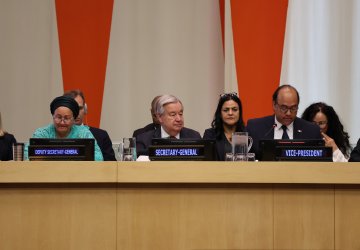
Following are UN Secretary-General António Guterres’ remarks to the opening of the Economic and Social Council’s Operational Activities for Development Segment for 2026, in New York:
The report I present today reflects a shared journey over nearly a decade. A journey marked by change, by difficult choices and by steady, determined transformation. We began in 2017 with a clear objective: to ensure that the UN development system could support countries in achieving the Sustainable Development Goals (SDGs).
The reports I presented at that time provided a candid diagnosis. The system was too fragmented when coherence was required; too internally competitive when collaboration was essential; too limited in structure and capacity to effectively respond to the needs of countries and people.
Reaching our objective required ambition. It required: closely aligning the UN development system with the Sustainable Development Goals themselves; using the Pact for the Future to guide us, particularly its emphasis on better use of digital technology and artificial intelligence (AI); better aligning functions to country priorities; strengthening capacities to deliver on country needs, enabling United Nations Development Programme (UNDP) to focus on operational delivery; and ensuring effective leadership and coordination within UN country teams.
Together, with the strong support and guidance of Member States and colleagues across the system, we have reshaped how we operate.
At the centre stands a strengthened resident coordinator system — empowered, independent, accountable and equipped to meet Member States’ expectations. Cooperation Frameworks are enabling the system to work more closely around national priorities. The UN development system has strengthened its coordination and responses. And we’ve reinforced accountability and transparency across the system.
Together, the UN and Member States agreed on a Funding Compact — to provide more flexibility and predictability of resources to allow the system to work better together.
The report I am presenting today demonstrates the results of these reforms. Recent surveys show that 94 per cent of Governments now assess UN development system support as effective.
The share of host Governments recognizing Resident Coordinators as effective entry points to the UN system increased from 62 per cent in 2019 to 90 per cent in 2025. And 80 per cent of host Governments report solid UN support in transformative areas — from food, health and education to digital learning and climate action.
These results are reflected in people’s lives: more people receiving food assistance; more children gaining access to education; more individuals and families benefitting from social protection; and more national institutions better able to deliver on development.
We have also made progress on efficiency. In 2025 alone, UN entities reported well over $900 million in efficiency gains, including by streamlining services and supply chains, increasing the use of shared services and other measures. We will continue to relentlessly ensure sound financial stewardship of funds in the most effective and impactful way possible.
The United Nations development system today is more coherent, more accountable and more closely aligned with national priorities than it has ever been before. But, with less than 1,700 days until the 2030 deadline, many countries face growing pressures — slowing growth, rising vulnerabilities and debts, greater exposure to shocks, and shrinking fiscal space.
At the same time, development financing is declining at an unprecedented pace. The system is better equipped — but increasingly under-resourced. This is a defining moment.
The direction we choose now will determine whether the progress of the past decade holds — or unravels. I see four areas where action is essential to ensure the UN can deliver with the scale and urgency needed.
First — more effective alignment with country and regional priorities. Despite best efforts, the UN development system remains fragmented. This limits the ability of UN country teams to provide integrated responses.
Capacities present in country are not always the capacities needed to deliver the support required — including because country teams are responding to earmarked funding and project-based approaches. The work of regional teams often remains disconnected from needs on the ground.
Missed opportunities persist to unlock development resources by working together more efficiently. This is why we must bring reforms to the finish line — and raise their ambition. At the country level, we will continue reconfiguring country teams around Cooperation Frameworks with clear, sequenced targets and strategic funding pathways.
This also means more and better expertise that is easily accessible and better able to support governments in their development efforts. At the regional level, we will bridge the gap between regional capabilities and country-level impact.
Regional Platforms for Integration will unite capacities across development, humanitarian, and peace and security into light, responsive mechanisms — built to provide timely, agile support to countries.
This means no change in — or confusion of — mandates. Our goal is to ensure countries can access assets across the UN system to deal with complex challenges. To do this, we are recalibrating the leadership and capacities of the resident coordinator system.
We must ensure that resident coordinators can optimally lead country teams in fast-evolving contexts and apply the full extent of the UN development system’s support on key issues, including climate change.
We are also assessing potential mergers — between UNDP and United Nations Office for Project Services (UNOPS), and the United Nations Population Fund (UNFPA) and United Nations Entity for Gender Equality and the Empowerment of Women (UN-Women) — to strengthen our ability to advance sustainable development and gender equality, while advocating for the rights of women, girls and youth. At every step, we will respect mandates, consult with Member States and ensure that reforms do not affect ongoing UN operations.
Second — we are continuing the next phase of reform under the UN80 Initiative. UN80 contains key proposals to identify efficiencies and ensure a greater share of our resources — human and financial — are allocated for development results.
These include: joint knowledge hubs to streamline knowledge in priority areas; an expertise-on-demand mechanism for countries to access specialized UN capacity; a unified service road map to expand shared services; and a technology-accelerator platform and a system-wide data commons so countries can access the tools and information they need.
These are practical measures designed to channel more resources and capacity towards results on the ground. As we push forward on these important reforms, we will continue counting on the full engagement and support of Member States.
Third — funding. Contributions to the UN development system suffered the highest cuts among all development partners and are projected to decline further this year. Core funding remains well below agreed targets.
Most funding continues to be short-term and tightly earmarked — limiting flexibility and undermining collective priorities. And the resident coordinator system remains underfunded and dependent mostly on voluntary contributions — and faced a $46 million shortfall in 2025. This places coordinated delivery at risk.
While the provision of $53 million from the Regular Budget for the resident coordinator system was a step in the right direction, it is not sufficient. Sustainable structural change cannot rely on temporary measures. We need more stable, predictable and flexible funding. I urge Member States to reach the 30 per cent core funding target called for by the Funding Compact and help equip the system to deliver and succeed.
And fourth — in these final years towards 2030, we need Member States themselves to continue the push to achieve the SDGs. While the UN is reforming, Member States need to give coherent guidance across governing bodies of the UN development system.
They also need to ensure their national budgets are targeted to development, job creation, education and poverty eradication. In the context of today’s out-of-control military spending, countries need to re-prioritize and spend more on the instruments of peace and development and less on the instruments of destruction and death.
And I renew my call to Member States to support our efforts to reform the global financial architecture and deliver meaningful debt relief to countries swamped by debt. Last year’s Sevilla Commitment pointed the way forward, and I call on all countries to translate its great promise into reality for developing countries.
Our experience over the past decade has shown that change is possible. The system we have built is stronger — but its success depends on continued effort, commitment and support.
In short, reform can work — but we need to keep working together. Let’s continue building a stronger and more effective development system that delivers for countries and people everywhere.
Read the 2026 Secretary-General's Report on the Implementation of the QCPR.
Read the 2026 UNSDG Chair Report on the Development Coordination and Resident Coordinator System: Report | Online Interactive Version
This statement was delivered at the 2026 ECOSOC OAS.