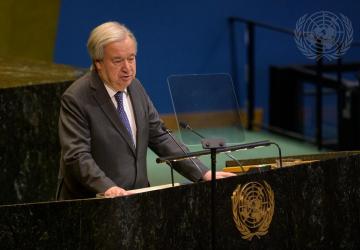
'Indigenous Peoples Respond With Knowledge and Care' - UN Secretary-General at the Permanent Forum on Indigenous Issues
Excellencies,
Dear friends,
I am pleased to welcome you to the 25th session of this vital forum.
We gather here to build on an enduring truth: Indigenous Peoples are bearers of cultures, knowledge, and ways of life that have sustained humanity for thousands of years.
From the Amazon to Australia, and Africa to the Arctic, you are the great guardians of nature, a living library of biodiversity conservation, and champions of climate action.
And your participation in global decision-making has never been more critical.
Our world today is roiled by division and discord.
We see conflicts over land and plundering of resources.
Nonstop environmental degradation.
Technologies that accelerate cultural erasure.
And inequalities that endanger the health and dignity of millions.
And too often, those who did the least to create these problems pay the heaviest price – especially Indigenous Peoples.
This Forum was established to address the persistent discrimination you face around the globe.
This includes rampant violations of rights, often taking the form of physical violence and even deadly attacks on individuals and communities.
Steep barriers to economic and social development.
Grave threats to language and culture.
Relentless encroachment on ancestral lands, from unlicensed logging that drives deforestation to illegal mining that poisons soil, groundwater, rivers, and food with mercury, cyanide, and other pollutants.
Rising sea levels that imperil Small Island Developing States.
School curricula that devalue the knowledge and histories of Indigenous Peoples.
And health systems that perpetuate inequities in the prevention and treatment of infectious and chronic diseases.
Excellencies and Dear Friends,
This Permanent Forum has made significant gains in combatting these injustices.
Starting with its role in securing the adoption of the United Nations Declaration on the Rights of Indigenous Peoples two decades ago.
And the momentum continues.
We can see it in the Pact for the Future and the Declaration on Future Generations, which affirm your rightful role in shaping the world of tomorrow.
And you can see it in the Doha Political Declaration, where Member States committed to supporting Indigenous Peoples with full respect for their identity, traditions, forms of social organization and cultural values – as well as the right to participate in decision-making processes.
Through it all, this Forum has provided a unique space where Indigenous Peoples from all regions can come together and be heard.
And this is why we must protect and strengthen it, ensuring it remains open, inclusive, and consequential.
And why we are working across the UN system to strengthen the architecture for advancing Indigenous Peoples’ rights.
Excellencies,
Dear friends,
Your theme for this session is a pivotal one.
For Indigenous Peoples, health is inseparable from your lands, waters, languages, cultures, and ecosystems.
When one is harmed, all are affected.
This is especially true in the context of conflict, when displacement from ancestral lands, loss of livelihoods, food insecurity, destruction of sacred sites, and disruption of cultural traditions can put health at risk.
It is also the case with contaminated water, which has immediate and intergenerational consequences on health and wellbeing.
For Indigenous Peoples, water is life – sacred and central to identity and survival.
That is why the 2030 Agenda for Sustainable Development – including SDG 6 on safe water – must continue to guide our actions.
Ensuring no one is left behind begins here.
Mother Earth is sending urgent signals: storms intensify, glaciers melt, seas rise, droughts grow more frequent, and floods get more severe.
Indigenous Peoples respond with knowledge and care.
Your wisdom offers solutions the world urgently needs.
We must listen, learn, and act.
But in too many venues and processes, the participation of Indigenous Peoples remains limited by practical, political, or institutional barriers.
And progress at the international level has not always translated into real change on the ground.
We must recognize these realities – and take steps to rectify them.
I see four areas where action is critical:
First, all Member States must honour their commitments under the Declaration on the Rights of Indigenous Peoples.
That includes embedding the rights of Indigenous Peoples in national laws and policies.
And it means ensuring free, prior, and informed consent for actions affecting their lands, territories, and resources.
Second, the UN system and Member States must ensure the full, meaningful, and direct participation of Indigenous Peoples at all levels, supported by adequate and sustained financing.
This must extend beyond global forums to national and local levels, where decisions are made and impacts are felt.
Third, societies everywhere must take immediate and concrete steps to protect Indigenous Peoples, their leaders, and human rights defenders – and to address the violence and risks they face.
Their individual and collective rights must be respected and upheld.
Fourth, we must all work to ensure that Indigenous women and girls can participate meaningfully in decisions that affect their lives.
Their knowledge, leadership, and perspectives must shape the way forward.
Excellencies,
Dear Friends,
The United Nations exists so all peoples from across the world can come together to address shared challenges.
This must include Indigenous Peoples in all their diversity.
In this time of profound global uncertainty, their wisdom and experience can guide us back from the brink.
Together, let us work to realize the rights of Indigenous Peoples everywhere – and build a better future of all humanity.
Thank you.
This statement was delivered at the Permanent Forum on Indigenous Issues.