'Growth at any Cost Leaves us all Poorer' - UN Secretary-General at the Launch of the 'Beyond GDP' Report
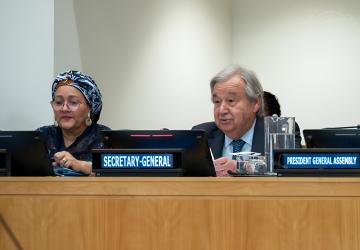
The report we launch here today is a landmark step in correcting a longstanding blind spot in measuring progress:
The over-reliance on Gross Domestic Product.
The report and its detailed recommendations are the result of focused work by a High-Level Expert Group.
I convened the Group in response to a clear call by Member States in the Pact for the Future to develop measures of progress that complement or go beyond GDP.
Over the last year, this multidisciplinary Group of academics and policy experts lent their insights and expertise, and consulted with stakeholders around the world.
I thank them for their valuable work.
Excellencies,
GDP is the most widely used metric of economic progress and well-being.
It will continue to be an important measurement.
But it cannot be the only one.
By design, Gross Domestic Product provides a clear and concise picture of a country’s market-based output.
It is purposefully narrow in scope.
But it is now being used in ways its architects never intended.
We use GDP to judge the long-term success of countries.
Yet we see a huge gap between what GDP measures and what people value.
GDP overlooks human activities that sustain life and contribute to well-being, while failing to fully account for those that harm people and deplete our planet.
In my time as Secretary-General, the size of the global economy has risen over 50 per cent, adjusting for inflation.
But our world has not seen commensurate improvements in many of the areas that benefit humanity.
Health. Biodiversity. Job-creation. Human rights. Equality.
And even peace — with conflicts now at levels not seen since World War II.
Meanwhile, deforestation, overfishing, and the burning of fossil fuels all are counted in GDP as Madame President of the General Assembly and Madame Co-Facilitator have reminded us.
We also treat GDP growth rates as a real-time barometer of a society’s health.
But GDP does nothing to capture or predict societal unease, frustration and mistrust in institutions, and whether prosperity is being shared.
In our world of deep inequality, GDP is indifferent to whether income goes to billionaires or to the poor — or if that income goes to addressing hunger, health or deprivation.
And GDP has become our go-to tool for international policy rules.
But it does not effectively distinguish the vulnerabilities, challenges or potential faced by different countries.
We cannot assume that, simply because they have more income today, countries have no need of international assistance, as demonstrated by the Multi-dimensional Vulnerability Index.
Nor can we assume that the sustainability of a country’s debts can be assessed solely on the basis of what that country earns, ignoring the value of its assets and how its borrowing is being used.
Excellencies,
These disconnects are especially relevant today.
With the rapid rise of Artificial Intelligence, humanity is on the cusp of a technological revolution — [comparable] to the industrial revolution.
AI holds the potential to dramatically boost global growth and productivity.
But it can equally eliminate millions of jobs, and unleash the creation and use of increasingly sophisticated deadly weapons.
Surely, we should not judge the merit of this technology by its effect on GDP alone.
Excellencies,
Our world needs a more sophisticated, more diverse, and more humane accounting system.
One that consciously aligns metrics with our actual goals — not proxy measures that obscure or hide the challenges our world is facing.
This report builds on decades of pioneering research, country-led initiatives and data development.
The Beyond GDP dashboard we are proposing is built on the vision of sustainable development and its 17 Goals.
While the Goals provide a full articulation of our aspirations for people and planet, the Beyond GDP dashboard provides a practical compass that can be used to guide every-day decisions.
The dashboard comprises a set of specific indicators focused on equitable and sustainable well-being in four key areas.
First — indicators around the well-being of our people and planet.
Work, health, education and security.
The quality of civic institutions and infrastructure.
And environmental conditions, which sustain the air we breathe, the water we drink and the food we eat.
Second — indicators around equity and inclusion.
We can no longer accept inequality, poverty and disparities across population groups and entire regions as facts of life.
Equity is the foundation of social cohesion — and a pillar of peace.
Third — indicators around sustainability and resilience.
Focusing solely on the income we generate today is insufficient.
We must also find ways to preserve and build on countries’ existing assets and advantages — including nature and knowledge — that can power progress into the future, while addressing existential challenges like climate change.
And fourth — indicators rooted in the foundational principles of peace, human rights and respect for the planet, upon which all progress depends.
These principles are directly derived from the UN Charter.
The arrival of the Beyond GDP agenda at the UN responds to the clear call by Member States to ensure this issue is guided by UN ideals.
And it recognizes that, in our deeply connected world, what happens in one country can influence and affect what happens in another.
This global issue demands the unique global platform the UN provides.
Excellencies,
The next step belongs to Member States.
The intergovernmental process starts now.
Your role is to consider the recommendations in this report, and agree on a plan to establish, refine and institutionalize the dashboard.
Governments, civil society, media, statisticians, businesses and international organizations need to work as one to bring the indicators to life in your countries.
And international financial institutions must take these indicators into account in their decision-making processes.
You can count on the UN’s support every step of the way.
Excellencies,
Today’s report is a clear reminder:
GDP is not enough.
Growth at any cost leaves us all poorer, not richer.
The report is also a call to action.
Let’s count what matters.
Let’s embrace these new metrics that complement GDP, and reveal the full picture of the challenges and opportunities our world faces at this extraordinary moment in history.
Thank you.
This statement was delivered at the Plenary Meeting of the General Assembly to launch the Expert Group report on 'Beyond GDP'.