'Every Fraction of a Degree of Warming Matters' – UN Deputy Secretary-General at Climate Week
Excellencies, Ladies and Gentlemen,
Thank you to the Climate Group for bringing us together.
I am grateful for the commitment and advocacy of so many distinguished leaders here today.
Non-state actors have moved the climate and development agenda from aspiration to implementation.
For more than a decade, you have helped test solutions, push governments further, and hold institutions, including my own, to account.
A whole generation has grown up during that decade. Young people have watched the promises being made, and they are increasingly impatient to see what those promises amount to in practice.
Whether its breakthrough solutions, championing justice, and holding governments and multilateral institutions to account – we need you as partners.
In a world marked by growing division and uncertainty, your efforts matter more than ever.
Ten years ago, world leaders agreed in Paris to limit global temperature rise to 1.5 degrees Celsius.
Despite the progress made since then, global emissions are still rising and the climate disasters are becoming more frequent, more destructive, and more costly.
Climate chaos is accelerating before our eyes. We have just lived through the hottest eleven years on record, and science tells us that the world will overshoot 1.5°C within the next few years, pushing us closer to catastrophic tipping points. El Niño and La Niña have always moved the climate pendulum, but now they are doing so in a world that is already hotter. What was once a natural swing can now land with much greater force.
Every fraction of a degree of warming matters. So does every year we spend above that line.
Meanwhile, conflict in the Middle East has triggered the most severe energy crisis in a generation.
The pressures on households, businesses, and indebted governments are reverberating across economies. For many developing countries already under severe debt pressure, an energy shock quickly becomes a development shock. It reaches the price of food and the room governments have to invest in schools, health systems and jobs.
But there is another side to this story: it can push us to double down on the opportunity of renewables.
Renewables are now the cheapest, fastest, and most scalable source of new electricity in most of the world.
Wind and solar are now leading all new electricity demand growth worldwide.
The economics are reinforcing this shift.
Capital is following: clean-energy investment is almost twice the investment in fossil fuels.
Grid investment is projected to rise almost 20% this year to around $550 billion, while battery-storage investment is expected to exceed $100 billion.
Now imagine what that can mean if we get it right: hospitals, schools and public buildings powered by affordable clean energy, cutting pollution while freeing public resources for development.
And for countries dependent on imported fossil fuels, renewables change the security equation too.
The sun and the wind do not arrive on a tanker. Their price is not determined by the next geopolitical shock.
For a young person looking at all of this, the climate transition has to offer more than another warning about the future. It has to offer a future worth building.
But we still need to go further, faster, and with much greater fairness. The current model is no longer fit for purpose.
A 1.5-degree overshoot must be a rallying cry for faster action.
Even if temperatures later fall back below that threshold, some losses will not be reversed, and many communities will be living with changed conditions for generations. That is why we have to cut emissions while adapting to the impacts already upon us. We have to do both, together.
So, I have three asks of the leaders in this room.
First, help us make the overshoot above 1.5 degrees as small and as short as possible.
This means governments over-delivering on their national climate plans, accelerating the transition away from fossil fuels, and answering the Secretary-General’s global Call to Action on Methane with much deeper cuts this decade.
It means building (but also adapting the current one) the infrastructure that can deliver this transition, by expanding grids, storage, and modern power systems to carry clean power to every home, promoting clean cooking as well.
A truly just transition must live up to its name – no one can be left behind.
A just transition rests on decent and greener jobs and strengthening social safety nets for affected workers, and ensuring countries and communities are the first to benefit from the critical minerals in their own backyard.
‘Just’ also demands thinking about who gets the opportunity, not simply who bears the cost. Women and young people should be among those building the new industries, owning the businesses and shaping the decisions that come with this transition.
A generation of young people is already asking what place they will have in this new economy. We should have a good answer for them.
Our second task is to back the ambition with adequate finance.
The global financial system is failing the countries that need support the most.
In many developing countries, clean energy finance costs are two to three times higher than in advanced economies.
That entrenches inequality, and it determines which countries get to participate in the energy transition, while others are forced to watch it happen elsewhere.
Developed countries must keep their climate finance promises, with no backsliding.
The $300 billion pledged to developing countries must be delivered – with concrete steps to mobilize $1.3 trillion a year by 2035.
Adaptation finance must be tripled, ensuring it reaches those most at risk. Multilateral climate funds like the Green Climate Fund and the Fund for Responding to Loss and Damage must be replenished, and grant-based and predictable finance, especially for Small Island Developing States and Least Developed Countries, should be prioritised.
Finally, MDBs must be further boosted by their shareholders, including through bold recapitalization and further reforms.
Our third task is to protect lives before disaster arrives.
Climate impacts already threaten sustainable development, stability and security.
Climate change is warming the oceans and melting glaciers, leading to rising sea levels that threaten lives and livelihoods worldwide.
It is straining food and water systems, disrupting supply chains, es, damaging infrastructure, and deepening inequalities.
Overshoot means the threat only rises.
Adaptation and resilience must be treated as an international priority.
Adaptation can sound technical. For a family in the path of a flood, it is anything but. It is getting the warning in time. It is knowing the road and the water supply will still be there afterwards.
Resilience has to be built into the way countries plan for the future, and National Adaptation Plans are one of the clearest ways to make that happen.
And we need better preparation before disaster strikes and to fully implement our Early Warnings for All Initiative.
Adaptation saves lives, protects livelihoods, and strengthens economies.
Let me end by saying that in this moment, when geopolitics are so fraught, we cannot afford to lose sight of the promise of the Paris Agreement and the Sustainable Development Goals.
We cannot allow climate cooperation to become another casualty of division.
The Paris Agreement and the Sustainable Development Goals are promises to the same people.
A promise to the young person wondering whether there will be a job for them in the economy we are building.
Equally, a promise to the woman whose livelihood depends on land increasingly exposed to drought or flood.
Success on one depends on success on the other.
We can still bring warming back below 1.5 degrees by the end of the century, but only through much greater cooperation.
And everyone in this room has some part of the machinery needed to move faster.
So use it.
Push governments further.
Move capital towards solutions that work.
Keep implementing.
Thank you.
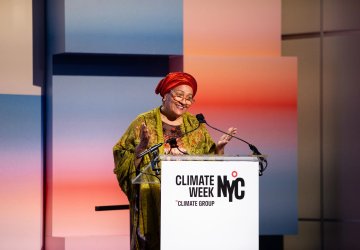
These remarks were delivered by UN Deputy Secretary-General Amina J. Mohammed at the opening of Climate Week in New York City.