PCR pour les États arabes
Plateforme de collaboration régionale
Au niveau régional, les plateformes de collaboration régionale réunissent toutes les entités des Nations Unies chargées des questions de développement pour le Programme 2030 afin de répondre à des défis majeurs qui dépassent les frontières des pays et des territoires, tels que ceux liés à la santé ou à l'environnement.
La plateforme de collaboration régionale des États arabes est présidée par la Vice-Secrétaire générale de l’ONU et coprésidée par deux Vice-Présidentes : la Secrétaire exécutive de la Commission économique et sociale pour l’Asie occidentale (CESAO) et la Directrice régionale du Programme des Nations Unies pour le développement (PNUD) pour les États arabes.
Les membres du PCR pour les États arabes sont la CESAO (Vice-président), PNUD (Vice-président), ONU DESA, ONU CEA, FAO, OACI, FIDA, OIT, OIM, UIT, OCHA, HCDH, ONUSIDA, CNUCED, PNUD, PNUE, UNESCO, FNUAP, ONU-HABITAT, HCR, UNICEF, ONUDI, ONUDC, UNOPS, UNRWA, VNU, ONU FEMMES, PAM, OMS, OMM, et la BANQUE MONDIALE.
Présidente
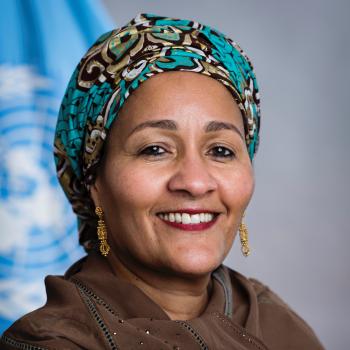
Amina J. Mohammed
Mme Amina J. Mohammed a été Ministre de l’environnement de la République fédérale du Nigéria de novembre 2015 à décembre 2016. En cette qualité, elle a dirigé l’action menée au niveau national pour le climat, la protection de l’environnement et la conservation des ressources dans la perspective du développement durable.
Auparavant, elle a occupé auprès du Secrétaire général Ban Ki-moon les fonctions de Conseillère spéciale pour la planification du développement après 2015 et a, à ce titre, joué un rôle déterminant dans l’élaboration du Programme de développement durable à l’horizon 2030 et, en particulier, des objectifs de développement durable.
Avant d’entrer au service de l’Organisation des Nations Unies, Mme Mohammed a servi l’État nigérian sous trois gouvernements successifs en tant que Conseillère spéciale sur les objectifs du Millénaire pour le développement. Sa mission a notamment consisté à faire des recommandations sur les questions relatives à la lutte contre la pauvreté, à la réforme du secteur public et au développement durable, et à coordonner des programmes d’un budget annuel de 1 milliard de dollars en faveur de la réalisation desdits objectifs.
Mme Mohammed a également été maître de conférences en pratique du développement à l’Université Columbia. Elle a été membre de nombreux conseils et comités consultatifs internationaux, dont le Groupe de haut niveau chargé du programme de développement pour l’après-2015 établi par le Secrétaire général de l’Organisation des Nations Unies, le Groupe consultatif d’experts indépendants sur la révolution des données pour le développement durable, le Global Development Program de la Fondation Bill et Melinda Gates, l’Initiative du millénaire des femmes africaines, Girl Effect, le comité créé en 2016 aux fins de la réforme de l’Union africaine et le projet d’ActionAid International sur le droit à l’éducation.
Mme Mohammed a commencé sa carrière il y a trente-cinq ans dans le secteur privé, où elle a géré aux côtés d’architectes et d’ingénieurs des projets de construction d’établissements scolaires et médicaux et de bâtiments publics.
Vice-Chair
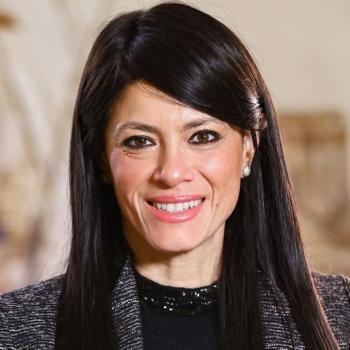
Rania A. Al-Mashat
Rania A. Al-Mashat of Egypt was appointed as the Executive Secretary of the Economic and Social Commission for Western Asia on 20 April 2026. Ms. Al-Mashat is an international expert in economic diplomacy, bringing over 25 years of experience in macroeconomic policy; central banking and monetary policy frameworks; sustainable economic and social development; structural and institutional reform; development cooperation; development and climate finance; and driving climate action and gender equality through international cooperation and partnerships. She served for eight consecutive years (2018-2026) as Minister across three key portfolios: Tourism (first female), International Cooperation and Planning, Economic Development and International Cooperation.
Before her ministerial positions, Ms. Al-Mashat served as Sub-Governor for Monetary Policy at the Central Bank of Egypt (2005-2016), where she played a key role in modernising the Bank’s monetary policy strategy. Her experience also includes working as Advisor to the Chief Economist and Senior Economist at the International Monetary Fund (IMF) in Washington, D.C. (2016-2018 and 2001-2005). She has been a board member and advisory member of several international alliances, international financial and development institutions, including the World Bank Group, the European Bank for Reconstruction and Development, the European Investment Bank, the African Development Bank and the Islamic Development Bank.
Ms. Al-Mashat has operated at the intersection of policy, finance, international and development cooperation, and had to manage complex domestic and geopolitical dynamics that influence institutional strategy and execution. She has led institutional change while maintaining predictability and credibility. A strong advocate of multilateralism, she has a proven track record of advancing impactful, partnership-driven national and global initiatives and has promoted innovative approaches to international cooperation and development finance through country-led multi-stakeholder engagement frameworks.
Ms. Al-Mashat holds a PhD in Economics from the University of Maryland, College Park, USA, and a BA in Economics from the American University in Cairo, Egypt. She completed executive education programmes in Leadership and Public Policy from the Harvard Kennedy School, USA, and Transformational Leadership from Oxford University’s Saïd Business School, United Kingdom. Her academic contributions, including publications with the IMF and the London School of Economics, reflect her commitment to bridging policy, research and practice. In addition to her native Arabic, she is fluent in English and has knowledge of French.
Vice-Chair
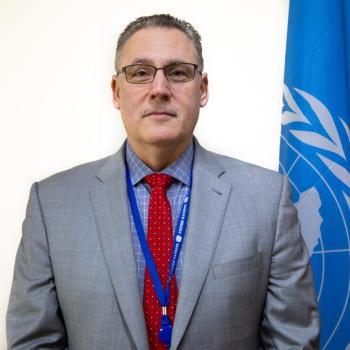
Abdallah Al Dardari
United Nations Secretary-General António Guterres announced on 14th March 2023, the appointment of Abdallah Al Dardari of Syria as Assistant Secretary-General, Assistant Administrator and Director, Regional Bureau for Arab States of the United Nations Development Programme (UNDP). He succeeds Khalida Bouzar of Algeria, who retired after working over three decades in various United Nations agencies and to whom the Secretary-General extends his deepest appreciation for her dedicated years of service.
Prior to this, Mr. Al Dardari served as UNDP Resident Representative in Afghanistan, a post that he has held since 2019, when joining from the World Bank, where he was a Senior Adviser.
He started his professional career in 1986 as an international affairs writer and bureau chief of the pan - Arab newspaper “Al Hayat” and then became the Economist at the London Office of the Arab League. From 1994 to 1997, he served as Programme Officer in UNDP Syria country office and then joined the Arab Trade Financing Programme/Arab Monetary Fund group as Chief of the Trade Promotion section. He was appointed in 2003 as Chairman of the State Planning Commission in Syria, a function he held until 2005, when he became Deputy Prime Minister for Economic Affairs. He further served as Chief Economist with the United Nations Economic and Social Commission for Western Asia in 2011 and later, Deputy Executive Secretary, where he led the efforts for understanding conflict dynamics in the Arab region.
Mr. Al Dardari holds a Bachelor of Arts in Economics from Richmond College in London, UK, a Master's in International Relations from the University of Southern California, US, and an interdisciplinary PhD in post-conflict reconstruction from Università Iuav di Venezia, Italy. He also studied international relations at the London School of Economics, UK. He is fluent in Arabic, English and French, with an understanding of Russian and Turkish.
Dernières actualités et mises à jour